.jpg?width=354&height=354&name=Image%20(82).jpg)
Batch 1: Foundations
Discussion 1: Pilots vs production
Christopher Frenning (Microsoft) and Wilfred Østgulen (National Library) opened the day. The question was why some AI pilots scale and others quietly stall.
Pilot and production are different problems. In pilot mode you ask whether the model can do something impressive. In production the questions are harder. Can we trust it? Can we govern it? Can we afford it at scale? Does it work in Norwegian? Does it work on our data? Does it improve a workflow that actually matters?
The point that stuck with me, and that several attendees pulled out of the day afterwards, was on language. Large global models are powerful, but they aren't automatically good enough for Norwegian, and considerably less so for smaller language communities like Sámi. That's a production constraint, not an academic one. Wilfred laid out what the National Library is doing about it: building their own open-source models adapted to Norwegian, because Norwegian organizations can't blindly trust models trained primarily on English. His closing framing captured the room: you can't scale what you don't trust, and you can't trust something that doesn't understand you.
Christopher's other contribution was framing AI as a democratizing force. The technology increases the power of each individual. More people can code, design, analyze and solve harder problems than they could two years ago. That only becomes value when organizations know how to absorb it. The pattern the panel kept returning to: AI works when top-down leadership meets bottom-up energy. Either alone doesn't get you there.
Discussion 2: Data as the bottleneck
Anne Ruth Gjerstad and Jan Robert Heiberg from Posten Bring, with Audun Hoff from Oracle, took on whether data readiness is still the genuine blocker or has become a convenient excuse. The answer wasn't binary.
The survey gives Scandinavian organizations an average data foundation score of 5.3 out of 10. Leaders we interviewed pointed repeatedly to data quality, ownership and accessibility as binding constraints. The panel agreed those constraints exist.
The harder point from the discussion was that perfect data isn't the goal. The teams making progress build momentum by making data usable in specific workflows, with domain experts close to the problem. Data foundations matter but treating them as the prerequisite gate becomes the excuse for never shipping.
The line worth carrying out of the session: AI makes the absence of data discipline visible faster than anything else.
Discussion 3: What the research tells us
This session focused on Antire’s AI Survey, and to comment on the findings we got the help from Anne Lisæth Schøyen (Deputy Director IT Development at The Norwegian Offshore Directorate) and Geir Inge Stokke (CEO, Norwegian Road Federation) alongside her. The framing question was whether Norwegian organizations are as far along on AI as they think they are.
The honest answer is no. The survey shows strategic ambition with limited operational depth. 56% report AI in support functions only. 16% are still mostly in PowerPoint and pilot mode. None describe AI as broadly embedded in core operations.
The most important finding wasn't technical. 56% of respondents named culture as the biggest barrier to further AI adoption, ahead of leadership, talent, funding and regulation. That matched what came up through the rest of the day. AI is a leadership and culture problem with a technology component. Treating it as an IT project is one reason so many organizations are stuck.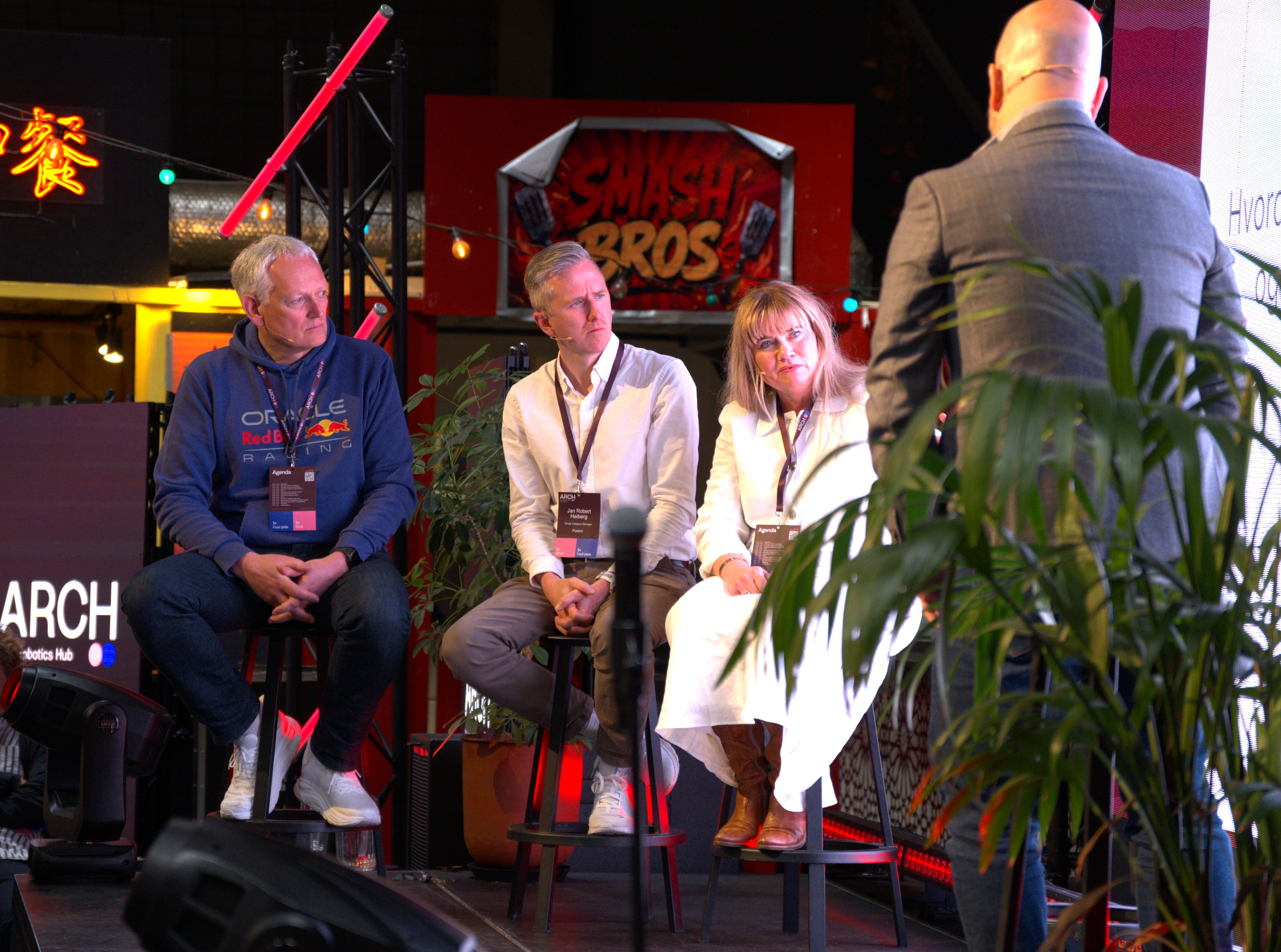
Batch 3: The Impact
Discussion 7: Robotics reality check
Robotics in Norway is both overhyped and underbuilt at the same time, and on this panel that came out clearly. We're probably overhyping humanoid robots in the short term, especially for complex household and open-world tasks. We're probably underbuilding practical robotics in industrial, logistics, infrastructure and operational environments where Norway has needs and competitive advantages.
The next five years will bring rapid progress. The winners won't be the teams with the most impressive demos. They'll be the ones combining functional hardware, reliable software, operational understanding and a clear business case, as demonstrated in this session by Stein H Danielsen, Co-Founder & Chief Solutions Officer at Cognite, Mia Norman, VP of Engineering at Wheel.me and Andreas Mollatt, Co-Founder at Physical Robotics AS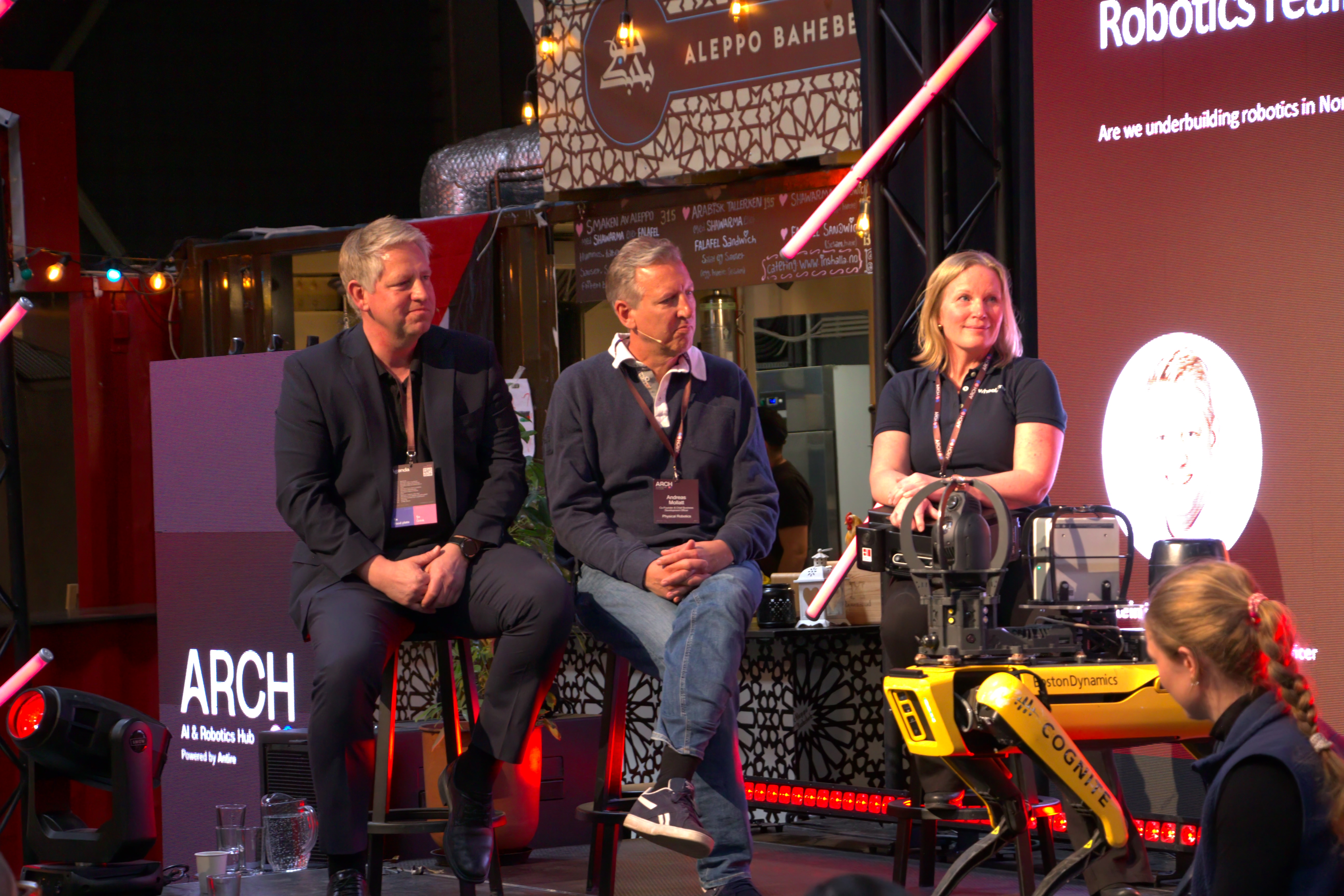
Discussion 8: Trust, legitimacy and public adoption
Lídice Nahomi González from ANIA, El Salvador's national AI agency, spoke from outside the Norwegian frame the rest of the day operated in. El Salvador has ambitious goals, and are willing to take a big bet on moving fast, in a way we might not be used to in Europe.
For public services, education, health and citizen-facing systems, people need to understand why AI is being used, how decisions get made, who carries responsibility, and what happens when something goes wrong. Explainability is hard. Trust can't be treated as an afterthought.
The El Salvador frame also reminded the room that AI can be a national transformation tool, not only an enterprise productivity tool. Used well, it can lift education, access to services and public-sector capacity. Used poorly, it deepens inequality and distrust.
Discussion 9: Norway's tech competitiveness
The ARCH Fellowship 2026 cohort presented three projects, with Gard Thomassen (IT Director, University of Oslo) closing the day on the broader question.
Norway's skills gap is the urgent question. Several threads came together in the discussion: AI literacy, national capability, local models, open ecosystems, leadership responsibility, lifelong learning.
If AI increases the power of each person, then the countries that win are the ones that help their people use that power well. That requires a serious lifelong learning agenda for leaders, case workers, clinicians, analysts, operators, teachers and everyone whose work will change. Engineers and students are part of it, not the bulk of it.
The risk is a large segment of the workforce left outside the next productivity wave. Slower companies are the smaller version of the same problem.


Where do you want technology to take you?
Get in touch