Value creation
Our expertise
- Antire accelerators
Proven building blocks, from architectures and code to models and domain expertise
- Antire Value Center
Forward-deployed engineers who bring measurable value to your operations in weeks
Partnerships
Your AI journey
- AI maturity quiz
Score yourself across five dimensions in under five minutes
- AI maturity assessment
Get an interactive AI investment dashboard delivered by our experts in just a few weeks
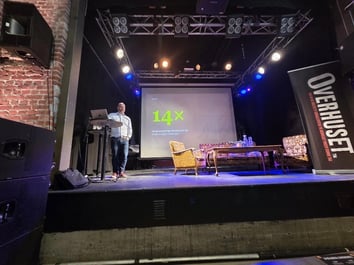
GitHub now sees about 14 times as much code committed as it did a year ago, and almost all of that surge comes from AI agents, not people. Every competitor you have can buy that same capability tomorrow, which is exactly why it won't set you apart. What will is the data you already own, and most companies treat it like a filing cabinet while they chase the next shiny model.
I made that case at Kongsberg Agenda 2026, hosted by Overhuset at Energimølla, in front of a room of people deciding where their AI budget goes this year. The opening number is seductive because it looks like progress. GitHub's COO, Kyle Daigle, has said (FinanceBigGo)he platform went from around a billion commits in all of 2025 to a pace of roughly 14 billion this year, almost entirely from AI coding agents rather than a wave of new developers. But volume that everyone can buy is just the new baseline, and the gold rush around it is already straining at the top, where some of the biggest buyers are taking a step back. Uber's president and COO, Andrew Macdonald, has said the company cannot yet draw a line between its AI spending and any real gain for customers (Fortune), and Amazon scrapped its internal AI usage leaderboard after staff began inflating activity instead of shipping useful work (The Decoder).
So where does the real value sit? In the assets themselves. In one case, on a fleet of multi-megawatt machines, vibration analytics caught a failing main bearing more than a year before it broke, while operators watching only the temperature alarms found out in the last stage of the damage, when the cheap options were already gone (Wind Systems Magazine). The signal had been in the data the whole time. The machine was talking, and whether anyone was set up to listen was a different question. Every business has its own version: a vessel consuming more fuel than it should, a machine running slightly slow, a customer quietly on the way out, a warning that shows up in the data months before it ever reaches a report.
This is where the ChatGPT comparison earns its keep. A large language model is a brilliant general tool, and so is the electricity running your building, but neither one is your business nor is setting you apart. Your data is everything you have built and run on top of it: the operational history, the sensor records, the decisions you made and what came of them. All of it is yours, and none of it is your competitor's. Linus Torvalds, who created the technology GitHub itself runs on, made the wider point years ago when he said the tool was never the point (lwn.net). The people who understand the system get value out of it, and everyone else just gets more noise.
That is why a license makes a poor moat and your data makes a strong one. Anyone can buy the license today, everyone gets a little faster, but nothing really changes between you and the firm next door. Your data cannot be bought at any price. It is earned over years of operation, and the lead it builds compounds every month, so the company that starts now keeps pulling away from the one that waits. A competitor can copy your tools over a weekend. They cannot copy your history.
So before you renew another AI license, write down the data your organization produces every day and does nothing with. That list is your AI strategy, and the rest is tooling. Then look at what happens to that data next. Is it structured? Is it connected to the systems around it? Can people find it, trust it, and use it? If the answer is no, that is probably the bottleneck. The signal may already be there. The question is whether your organization is set up to see it.
The next phase of the AI race will not be won by organizations with access to the best models. Those are available to everyone. It will be won by organizations that can turn years of operational history into usable knowledge. The companies building that foundation today are the ones creating an advantage that compounds tomorrow.