
As we approach the last days of the year, it’s timely to step back and look at what happened in AI in 2025 - and what 2026 is likely to bring. AI moved from novelty to infrastructure. Regulation started to bite. And the real competitive advantage shifted from ‘having AI’ to extracting measurable value from it.
The China shock
If we go back to the first part of the year, it was dominated by the fear of the Chinese. “This is it. The west is doomed”. You remember… DeepSeek came out of nowhere and dominated the discussion for months. The US AI stocks dropped, and everyone was suddenly convinced that the Chinese had finally won. The claim was that the model cost only $6 million in pre-training cost and outperformed everything else.
“This was it for the west. Nice as long as it lasted. “
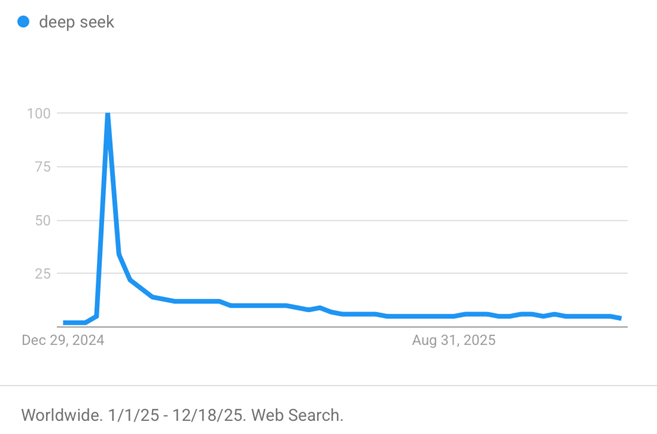
Illustration: World wide web searches on deep seek from the year of 2025.
It didn’t take long before the questions came. The hedge fund, High-Flyer, that owned DeepSeek has 10 000 GPUs worth $150 million. Did this really cost only $6 million? And what about the copyright controversy? Hmm……
Regardless, still impressive what they did, and DeepSeek is credited with several very clever ways of making LLMs more efficient. But as of now, the west is still in the game.
A bubble? Or maybe not?
The second part of the year got a new theme: “The AI bubble”.
Do we have an AI bubble?
Yes, by all means. There is no doubt that we are experiencing a bubble. But that does not mean that AI is a bubble. The value of AI is here for sure. The AI bubble is in the markets.
Oracle’s stock price jumped from $239 to a peak of $345 after the September AI-related enthusiasm. A company of that size that jumps about 5.3x the Equinor market cap overnight? That is bubble-territory. Oracle is back at $178 as I write this in December.
But don’t misunderstand. AI is not a bubble in all aspects. The value is clear. Of course, we will talk about and use AI in 3 years, 5 years and 20 years. So, the use cases and the value is here. But I am sure some investors will look back at 2025 with some regrets and thinking “Why didn’t I take some money off the table. A P/E of 586 was never a good buy signal”.
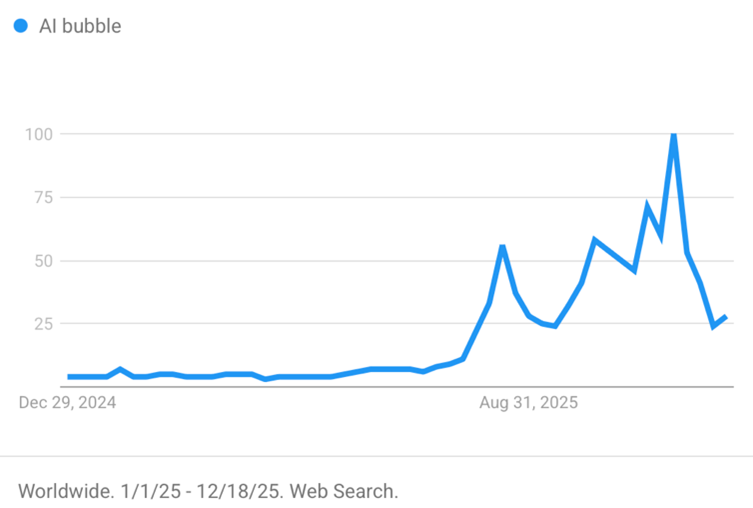
Illustration: World wide web searches on AI bubble from the year of 2025.
The coming of age
But in a way, we can say that AI came of age in 2025. It has in many aspects reached maturity and has proven its value.
David Bressler, a guy with 6 weeks paternity leave and no coding skills, wanted to create something of his own. He made Formula Bot, completely made with AI tools, have now more than 1 million active users. The company still has only one employee, and this employee created the MVP in 2 days. Formula Bot was the first known example, but in the years to come, there will be millions, and things will never be the same.
On the other hand, “the wild west of AI” is also coming to an end. Anthropic had its landmark $1.5 billion proposed settlement that signaled a more regulated era for training data.
Humanoids have been another hot topic this year. The investments in humanoids in 2025 have passed $3 bn, compared to $1.4 last year. Of course, the exact numbers and what they include can be discussed. But the trend is clear.
What will the next year bring?
The boring answer is more of the same. We will get better models every week, we will get more realistic answers and even more excuses not to do anything manually anymore.
To be a little more concrete, we will see differences in regulations this year. Trump has issued an executive order to constrain state AI legislation, and the EU is discussing how to slow the enforcement of some of their regulations. This does of course not mean that “The wild west” is back on the menu. For that you must go to China.
As models commoditize, organizational capability becomes the differentiator
Next year we might see examples of open-ended agents that create a meaningful scientific discovery from end-to-end, as in from the hypothesis through all the stages through the paper. We might see that a Chinese AI-lab gets to the top of one of the AI-leaderboards. We might also see a deep-fake or an agent driven event create a bigger international political debate. And we will probably see that the biggest euphoria surrounding AI cools down a bit. That doesn’t mean that businesses will stop focusing on AI. But it will redirect the focus from “We need AI” to “What value can we get from AI”.
In other words, the time where one could get away with buying Copilot licenses to every employee, realize that only a single digit percentage of the employees use it, and still call this a digital transformation success story is over. A few unused licenses don’t count as “driving innovation”, “investments in AI” or “market leading AI adoption”.
That was so 2025.
In 2026, there will be more focus on value, where we measure adoption by outcomes, not by the number of licenses. That shift favors teams who can operationalize AI: pick the right workflows, fix data and governance, instrument outcomes, and scale what works.
Just perfect for Antire….